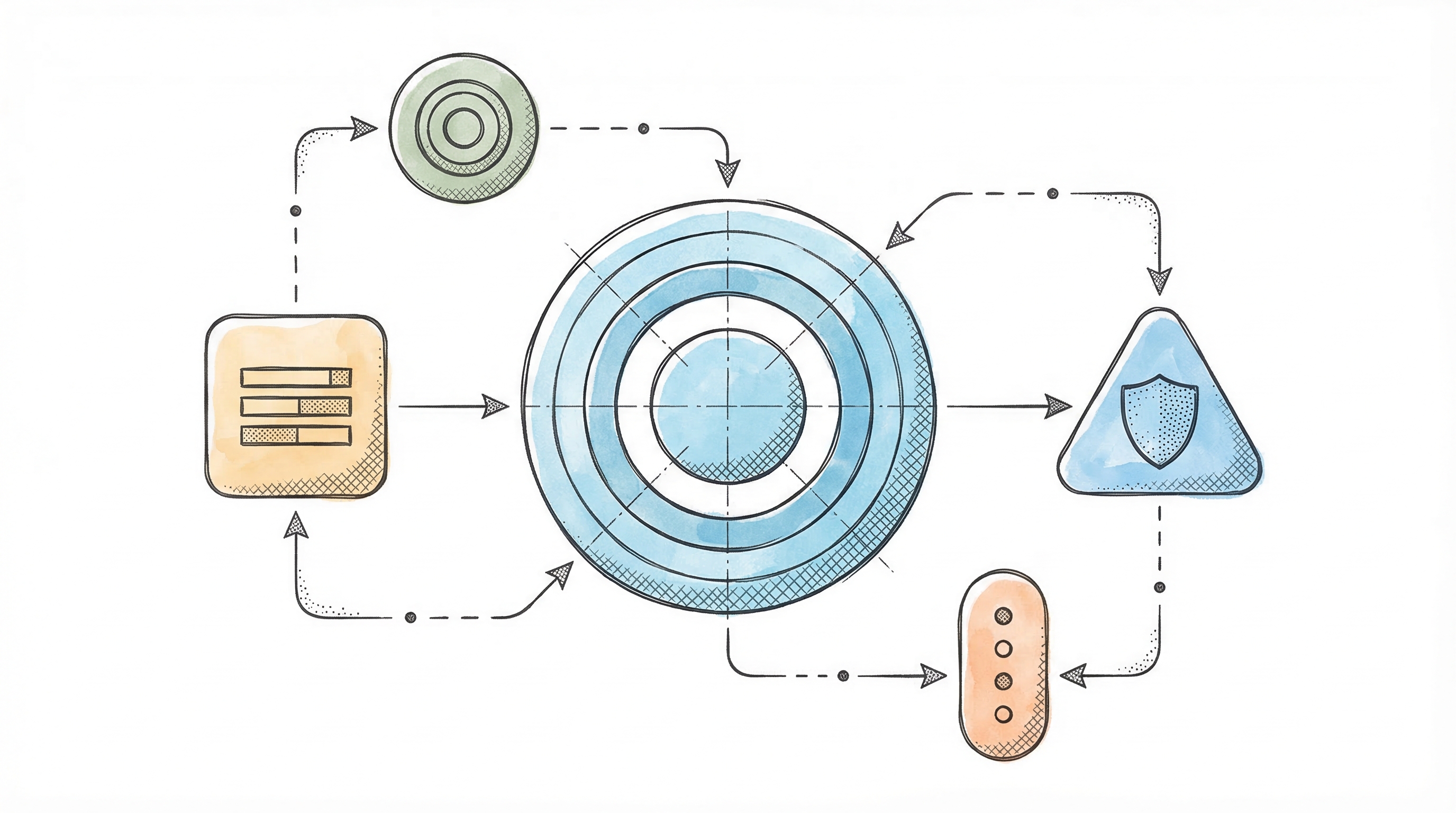
Multi-Agent LLM Architecture: Building Coordinated Systems with Logic

Distributed systems are familiar territory for most engineering teams. You've built microservices that communicate over REST, designed message queues that handle backpressure, and debugged race conditions in concurrent workflows. Multi-agent LLM architecture borrows from this playbook: multiple specialized agents coordinate to solve problems that exceed what any single agent handles well. The patterns map to what you already know about service decomposition, message passing, and state management. The performance gains are real, but the infrastructure required to ship these systems reliably is where most teams get stuck.
Why Multi-Agent Works, and Where It Breaks
Multi-agent systems inherit familiar distributed systems patterns, but the LLM layer introduces a problem microservices don't have: non-determinism. Traditional services produce identical outputs from identical inputs. LLM-powered agents don't. A prompt that generates reliable JSON today might produce subtly different structures tomorrow, even with identical settings.
The performance case for multi-agent is clear. Anthropic's engineering team demonstrated in their multi-agent research system that coordinating a high-capability lead agent with lightweight subagents outperformed a single agent by 90.2% on internal evaluations. Token usage alone explains 80% of the variance in performance on complex tasks, meaning multi-agent architectures scale by distributing work across separate context windows where a single agent physically can't.
The demo-to-production gap is where most multi-agent projects stall.
Why These Systems Break in Production
Multi-agent boundaries require the same explicitness as service boundaries: typed contracts, clear schemas, enforced handoffs. Failures at these boundaries are semantic. The system returns plausible outputs with missing constraints, and nothing in your logs flags the problem. Production failures cluster into three categories:
Specification and design failures account for the largest share. Agents silently drop required constraints or fail to recognize when a task is complete, and these issues surface only when downstream consumers act on incorrect outputs.
Inter-agent coordination failures are the second major category. Agents ignore each other's outputs, proceed without clarification on ambiguous inputs, or reset communication state mid-workflow. The coordination tax also scales non-linearly: four agents create 6 potential failure points, ten agents create 45.
Task verification failures round out the pattern. Agents declare success prematurely or perform incomplete checks, passing compilation or schema validation while missing semantic errors that only surface in production.
These categories compound in practice. An extraction agent returns valid JSON but interprets "total" as "subtotal." The next agent in the chain uses that value to trigger billing. Every log entry shows a successful call. The system failed at the contract layer because the spec did not unambiguously bind the meaning of a field, and no verification step caught the discrepancy. You find out when a customer disputes the charge.
The Infrastructure Gap
The infrastructure concerns that most teams significantly underestimate apply at every agent boundary: testability, version control, observability, model independence, repeatable deployments, and reliable responses. In practice, these translate into typed communication contracts enforced at runtime, testing that validates behavioral consistency across runs, rollback capabilities across agent boundaries, end-to-end observability, and cost controls preventing infinite reasoning loops. Anthropic's engineering team reports that multi-agent systems consume roughly 15x more tokens than standard chat interactions based on their multi-agent research findings, and without circuit breakers and token budget enforcement, costs grow unpredictably.
Beyond these core requirements, teams also end up rebuilding a familiar set of distributed-systems primitives, adapted for non-deterministic services:
Idempotency and retries: A worker agent called twice due to a timeout can create duplicated side effects, double-charges, or conflicting records. Most teams add idempotency keys and step-level replay rules so reruns are safe.
Schema evolution across agent boundaries: Even small changes, like renaming an enum value, become breaking changes when another agent is parsing that output.
Validation and error surfacing: JSON schema checks catch missing fields, but semantic checks are often needed too, like totals matching line item sums or categories matching allowed labels.
Rate limits and backpressure: Parallel agent execution increases burst traffic to model providers. Without queueing and budgets, orchestrators amplify load instead of smoothing it.
Security boundaries: Prompt injection and data leakage are coordination problems. The orchestrator needs rules about what can be passed to which agent, and what must be redacted before leaving a boundary.
Each of these requirements represents significant engineering work before your first agent reaches production. For a team with limited engineering bandwidth, that's time not spent building the product your customers pay for. These are well-understood distributed systems principles; most teams arrive at the same patterns after enough incidents. The question is whether your team should own or offload that infrastructure.
The Own vs. Offload Decision for Multi-Agent Systems
Building LLM infrastructure yourself gives complete control. Your team also builds rate limiting, retry logic, multi-provider routing with failover, prompt versioning, testing frameworks, observability, and schema validation before shipping a single agent.
Owning infrastructure makes sense when AI processing is central to what you sell. If the coordination layer itself is your competitive advantage, own it. For most teams, multi-agent coordination enables something else: document processing that feeds workflows, content moderation that protects marketplaces, classification that routes support tickets. When coordination is a means to an end, infrastructure investment competes with features that differentiate your product.
Teams using LangChain, CrewAI, LlamaIndex, or cloud services like AWS Bedrock and Google Vertex AI still build infrastructure for testing, versioning, deployment, and structured output handling themselves. Logic includes the production layer from day one.
How Logic Handles the Per-Agent Production Layer
Logic's spec-driven approach transforms natural language specs into production-ready agents with typed REST APIs, auto-generated tests, version control, and execution logging. You define what each agent should do; Logic handles per-agent infrastructure, model routing, and deployment. Your team composes multi-agent workflows by calling agents from your application code, with Logic ensuring each agent in the chain is production-hardened.
{{ LOGIC_WORKFLOW: moderate-product-listing-for-policy-compliance | Moderate product listings for policy compliance }}
Here's how Logic's infrastructure maps to multi-agent production requirements:
Typed API Contracts That Protect Agent Boundaries
Every Logic agent includes auto-generated JSON schemas from the agent spec with strict input/output validation enforced on every request. The API contract stays stable even as you update agent behavior. Spec changes fall into two categories: behavior changes (updated decision rules, refined rules) apply immediately without touching your API schema; schema changes (new required inputs, modified output structure) require explicit engineering approval.
For multi-agent coordination, this separation is critical. When your content moderation agent needs updated rules, the classification agent that depends on its output doesn't break. Logic also supports flexible input handling for backward compatibility and opt-in execution caching for high-volume, repeatable calls between agents.
Auto-Generated Testing for Behavioral Consistency
Logic automatically generates 10 test scenarios based on your agent spec, covering typical use cases and edge cases. Tests include multi-dimensional scenarios with realistic data combinations, conflicting inputs, ambiguous contexts, and boundary conditions. Each test receives one of three statuses: Pass, Fail, or Uncertain (differences requiring manual review).
When tests run, Logic compares actual output against expected output and provides side-by-side diffs, clear failure summaries, and structured analysis identifying specific fields or transformations that didn't match. You can add custom test cases manually or promote any historical execution into a permanent test case with one click from execution history. Test results surface potential issues; your team decides whether to proceed.
In multi-agent systems, teams often treat each agent's test suite as a contract. If Agent B expects a label set from Agent A, Agent A's tests include edge cases that stress that label set. When a spec change modifies behavior, failures show up as test diffs instead of as runtime surprises downstream.
Version Control with Instant Rollback
Each agent version is immutable and frozen once created. You can require review prior to publishing new agent versions, pin to specific versions for stability, and maintain complete audit trails. When updating one agent in a multi-agent workflow creates unexpected downstream effects, you roll back instantly without redeploying the entire system.
Automatic Model Orchestration
Logic automatically routes agent requests across GPT, Claude, Gemini, and Perplexity based on task type, complexity, and cost. Different agents in a multi-agent system have different computational demands: orchestrator agents benefit from sophisticated reasoning models while worker agents handling structured extraction or classification run efficiently on lighter models. Logic handles this routing without manual model selection for each agent, optimizing the cost-performance balance across all agents in the system. For teams needing strict model pinning for compliance or consistency, the Model Override API locks specific agents to specific models.
Execution Logging Across Agents
Every agent execution is logged with full visibility into inputs, outputs, and decisions made. Debug production issues without guesswork, monitor how each agent handled specific requests, and track behavior over time. No separate logging infrastructure to build or maintain.
In multi-agent workflows, this visibility applies per agent. When a downstream agent produces unexpected output, you can inspect exactly what each agent in the chain received and returned, narrowing the problem to a specific agent without reproducing the full workflow.
Logic in Production
Garmentory, an online fashion marketplace, built content moderation agents that scaled processing from 1,000 to 5,000+ products daily with Logic. Each agent operates through Logic's typed API with independent version control, so when moderation criteria change, downstream systems that depend on agent output don't break. Review time dropped from 7 days to 48 seconds. Error rates went from 24% to 2%. The system handles 190,000+ monthly executions, replacing 4 contractors and lowering their price floor from $50 to $15. Updates apply without consuming engineering cycles.
DroneSense built document processing agents that reduced processing time from 30+ minutes to 2 minutes per document. No custom ML pipelines required. The ops team refocused on mission-critical work instead of manual document review.
When you create an agent, 25+ processes execute automatically: research, validation, schema generation, test creation, and model routing optimization. That complexity runs in the background while you see the production API appear. You can prototype in 15-30 minutes what used to take a sprint. The platform processes 250,000+ jobs monthly with 99.999% uptime over the last 90 days across customers running enterprise workloads. Start building with Logic.
Frequently Asked Questions
How does chaining multiple agents affect overall workflow latency?
Chaining agents increases end-to-end latency because each step adds model time plus network overhead. Teams should map the critical path, run independent steps in parallel, and set step-level timeouts with fallbacks (for example, skipping enrichment when deadlines hit). For user-facing flows, teams often reserve deeper multi-agent chains for asynchronous jobs or background verification.
What cost dynamics matter most in multi-agent workflows on Logic?
Multi-agent workflows amplify cost through fan-out, retries, and verification passes. Teams should start by estimating worst-case executions per request (including reruns), then enforce a per-request budget and degrade gracefully when it is exceeded. On Logic, cost is easiest to control by limiting parallel branches, narrowing agent inputs, and using lightweight agents for high-volume steps.
How should teams decide where to draw agent boundaries?
Agent boundaries should follow stable responsibilities, not convenience. Teams typically separate steps when they have different failure modes (extraction vs. validation), different data access permissions (PII vs. redacted), or different change cadences (policy rules vs. formatting). If two steps always change together and share the same inputs, collapsing them often reduces coordination bugs and latency.
How should authentication and data access be handled across multi-agent workflows?
In most deployments, one agent does not directly call another; the application or orchestrator service makes calls on behalf of a user or job. Teams should use separate credentials per environment, restrict tokens to the minimum required agents, and treat intermediate artifacts as sensitive data. When an agent must see raw documents, downstream agents should receive only the redacted or structured subset they need.