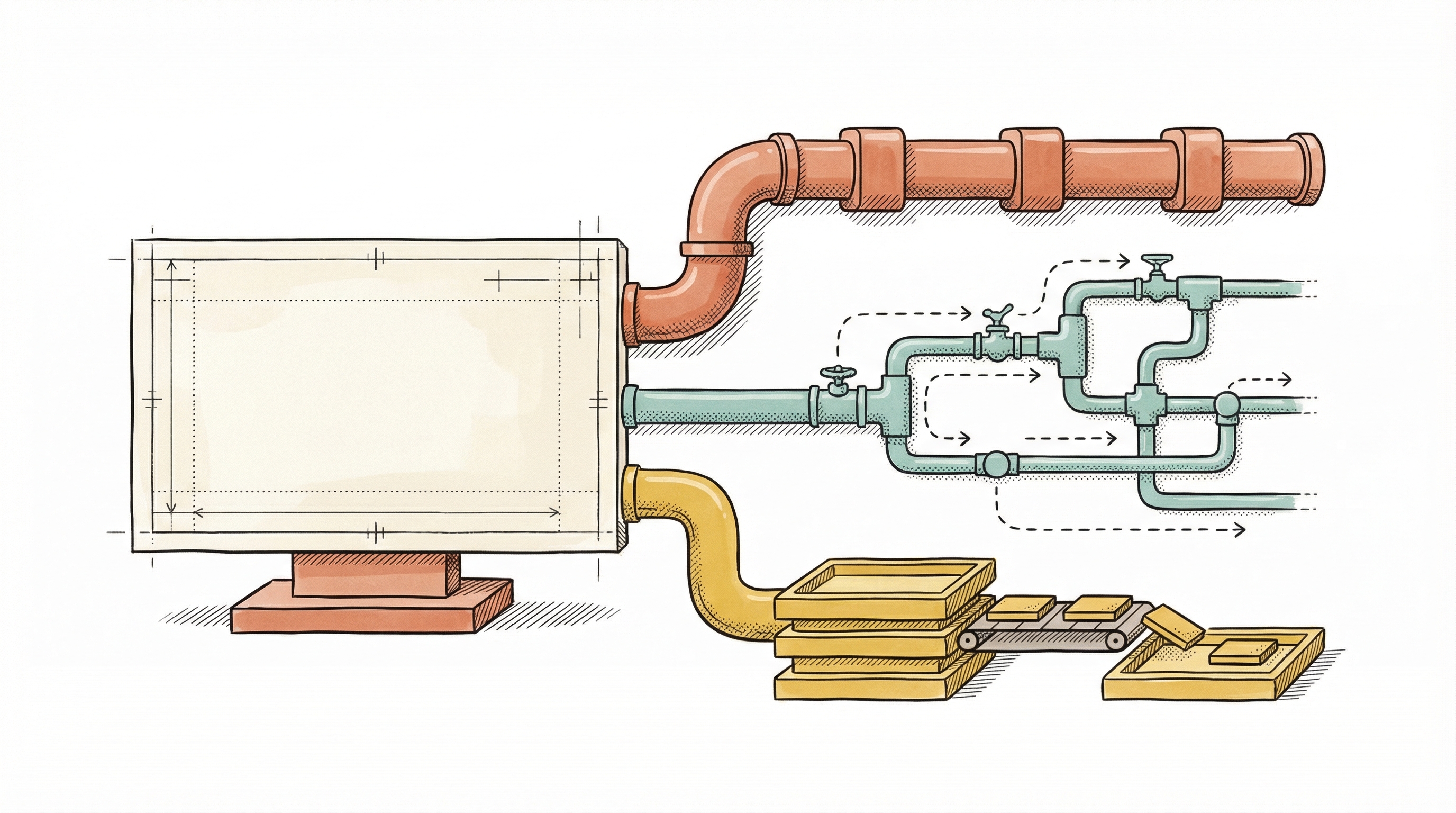
Top Multi-Agent Framework Options for Production AI

Adding multi-agent coordination to your product looks like a contained engineering project. Pick a framework, define how agents hand off work, and ship the feature. Most frameworks deliver on the orchestration piece: routing between agents, managing state, handling handoffs. That part works as advertised.
The infrastructure underneath is where timelines expand. Testing that validates the full agent chain rather than individual agents in isolation, version control that tracks how a prompt change in one agent affects downstream behavior, error handling for cascading failures across the chain, and execution logging that connects decisions across multiple agents: these are the production concerns that frameworks leave to your team. This comparison covers seven options across both dimensions, orchestration approach and production infrastructure, so you can evaluate what fits your stack.
How Multi-Agent Frameworks Compare
Each option below takes a different approach to agent coordination. The comparison focuses on two dimensions: which orchestration style fits your workflow, and how much production infrastructure is included versus left to your team.
Logic: Production Infrastructure Included
Logic takes a different approach from orchestration frameworks. Instead of providing primitives that you assemble into a production system, Logic's spec-driven approach lets you describe what you want and get a production API with the infrastructure already built in.
{{ LOGIC_WORKFLOW: moderate-product-listing-for-policy-compliance | Moderate product listings for policy compliance }}
Engineers write a spec describing the agent's behavior: what inputs it accepts, what rules it applies, what outputs it returns. When you create an agent, 25+ processes execute automatically: research, validation, schema generation, test creation, and model routing optimization. The result is a typed REST API with auto-generated tests, version control with instant rollback, and multi-model routing across GPT, Claude, and Gemini. When requirements change, you update the spec and the agent behavior updates instantly, while your API contract remains stable.
Teams building highly custom multi-agent architectures with dynamic sub-agent spawning or custom communication protocols may need the low-level control that other tools provide. Logic fits teams who need to ship AI capabilities to production quickly without diverting engineers to infrastructure work.
What's included: Testing infrastructure, version control (including prompt versioning), error handling, multi-model routing, execution logging, typed API generation, and deployment as REST APIs, MCP server, or web interface.
LangGraph: Graph-Based State Machines
LangGraph structures agent workflows as directed graphs, giving explicit control over how agents move between states. This architecture fits teams building workflows with complex conditional branching where agents may need to loop back or branch based on intermediate results.
The tradeoff is complexity. Defining state schemas, managing checkpointers, and handling graph cycles requires understanding LangGraph's execution model before writing application code. Because LangGraph extends LangChain, it inherits that ecosystem's abstraction layers and debugging challenges, and breaking changes in upstream updates can deprecate APIs with little notice. When requirements change, you're tracing node dependencies and reworking execution paths, not just updating a prompt.
What you build yourself: Testing infrastructure, version control (including prompt versioning), error handling, multi-model routing, and deployment pipelines.
OpenAI Agents SDK: Minimalist Handoff Architecture
The OpenAI Agents SDK takes a deliberately minimalist approach built around four primitives: Agents configured with instructions and tools, Handoffs for delegating between agents, Guardrails for input/output validation, and built-in tracing for debugging. The SDK supports 100+ LLMs through the Chat Completions API and is available in Python and TypeScript.
The minimalism that makes the SDK accessible also limits it. Teams needing complex graph-based workflows or fine-grained control over execution flow may find the handoff model too simple, and the SDK optimizes for straightforward agent coordination where development speed matters more than architectural customization.
What you build yourself: Version control (including prompt versioning), multi-model routing, and deployment pipelines. Testing and evaluation are partially covered through OpenAI's Evals platform but require separate configuration.
Google ADK: Hierarchical Multi-Agent Orchestration
Google's Agent Development Kit organizes agents into three types: LLM Agents for reasoning, Workflow Agents (sequential, parallel, loop) for deterministic orchestration, and Custom Agents for specialized behavior. ADK supports 100+ models through LiteLLM, includes MCP and A2A protocol support, and offers the broadest language coverage here: Python, TypeScript, Go, and Java.
The tradeoff is platform dependency. ADK is optimized for Google Cloud, and teams deploying outside Vertex AI lose access to Agent Engine's managed runtime and scaling. The framework is also relatively new (v0.5.0), which means thinner documentation and community resources than more established options.
What you build yourself: Version control (including prompt versioning) and deployment pipelines (unless using Vertex AI Agent Engine). ADK includes a built-in evaluation framework for testing agent performance.
CrewAI: Role-Based Agent Teams
CrewAI organizes agents into role-based teams that collaborate through sequential delegation. The "team of specialists" metaphor maps intuitively to how teams think about dividing work: a research agent feeds a drafting agent that feeds a review agent. CrewAI also offers a managed cloud platform (CrewAI Enterprise) for reducing operational overhead.
The challenge emerges when production workflows don't map cleanly to sequential handoffs. When agents need to backtrack, collaborate dynamically, or handle shifting responsibilities, the rigid role definitions create friction. Developer discussions report minute-level response times for hierarchical systems, and the abstractions can be difficult to debug when agent behavior diverges from what the role definitions intend.
What you build yourself: Testing infrastructure, version control (including prompt versioning), error handling, multi-model routing, and deployment pipelines (unless using CrewAI Enterprise).
Microsoft Agent Framework: Enterprise Unification
Microsoft's Agent Framework merges AutoGen's multi-agent orchestration with Semantic Kernel's enterprise features into a single tool targeting Azure environments. The framework supports Python and .NET, includes native Azure AI Foundry integration, and offers compliance features for regulated industries with MCP and A2A protocol support.
The framework remains in public preview with a GA target of Q1 2026, which means API surfaces may still change. Teams already on AutoGen or Semantic Kernel face an eventual migration, since both entered maintenance mode.
What you build yourself: Testing infrastructure and custom deployment pipelines (Azure-managed deployment covers some of this). Version control and execution logging are partially covered through Azure AI Foundry.
LlamaIndex: Retrieval-First Architecture
LlamaIndex provides infrastructure for connecting agents to external data sources, with core strength in document-heavy pipelines. The framework handles chunking strategies, index optimization, and query routing across multiple data sources, saving significant development time for RAG applications compared to building retrieval infrastructure on a general-purpose tool.
Teams whose workflows are orchestration-heavy but retrieval-light may find LlamaIndex adds complexity without matching benefit. If your agents primarily route requests, coordinate multi-step processes, or handle structured data transformations, the retrieval focus doesn't apply.
What you build yourself: Testing infrastructure, version control (including prompt versioning), error handling, multi-model routing, and deployment pipelines.
Side-by-Side Comparison
The table below summarizes orchestration approach, production maturity, and built-in infrastructure across all seven options.
Logic | LangGraph | OpenAI Agents SDK | Google ADK | CrewAI | Microsoft Agent Framework | LlamaIndex | |
Orchestration style | Spec-driven | Directed graph / state machine | Handoff-based delegation | Hierarchical (Sequential, Parallel, Loop) | Role-based teams | Graph-based workflow + single-agent | Retrieval-first pipelines |
Language support | Any (REST API) | Python, JS | Python, TypeScript | Python, TS, Go, Java | Python | Python, .NET | Python, TS |
Production maturity | GA, 250K+ jobs/month | GA, production deployments | GA (March 2025) | Open source, v0.5.0 | GA, limited production evidence | Public preview (GA Q1 2026) | GA (Workflows in alpha) |
Built-in testing | Yes (auto-generated) | No | Partial (via OpenAI Evals) | Yes (eval framework) | No | Partial (via Azure) | No |
Version control | Yes (instant rollback) | No | No | No | No | Partial (via Azure) | No |
Execution logging | Built-in | Via LangSmith (separate) | Built-in | Built-in dev UI | Limited | Via Azure (separate) | No |
Best for | Shipping without building infrastructure | Complex stateful workflows | Fast multi-agent prototyping | Google Cloud / multi-language teams | Sequential role-based handoffs | Azure enterprise environments | Document-heavy RAG pipelines |
The Production Infrastructure Gap
Every option above handles how agents coordinate. Most leave the infrastructure required for production deployment to your team, and multi-agent systems amplify that gap: a schema mismatch between agents cascades into workflow-wide failures, a prompt change in one agent can break downstream agents that single-agent testing won't catch, and debugging requires connecting decisions across the full chain rather than within a single execution.
Production AI agents require infrastructure that most teams significantly underestimate:
Testability: catching regressions before customers do
Version control: giving agents their own traceable, reversible lifecycle, including prompt versioning
Observability: understanding what decisions an agent made and when
Model independence: balancing cost, speed, and quality across providers
Robust deployments: treating agents as a distinct layer in your stack, decoupled from your backend
Reliable responses: taming the probabilistic nature of LLMs so they don't silently corrupt data
For multi-agent systems, teams also need coordination testing that validates the full workflow rather than individual agents in isolation. For a deeper look at evaluating this decision, see our infrastructure decision guide.
With the other six options in this comparison, your team manages most of this infrastructure or pays for additional platforms to cover parts of it. Teams evaluating cloud AI services face similar gaps. Logic includes all of it out of the box.
Making the Infrastructure Decision
The tools above give you orchestration primitives; you decide how much of the production stack to manage yourself.
When Managing Infrastructure Yourself Makes Sense
If your differentiation comes from proprietary orchestration patterns or novel agent architectures, the infrastructure work creates value rather than consuming it. It also makes sense when you have dedicated platform engineering capacity that doesn't compete with product development, or when compliance requires on-premises deployment.
When Offloading Infrastructure Makes Sense
Offloading makes sense when speed to production matters more than architectural control, or when engineering bandwidth is constrained. Early-stage startups where every engineer is needed for product development face compounding opportunity cost when those engineers build infrastructure instead.
How Logic Changes the Calculus
Building in-house means engineers spend significant time on testing harnesses, version control systems, deployment pipelines, and monitoring before the first agent reaches production. Logic compresses that timeline to minutes: you describe the agent in a spec, and the full production stack ships with it. The engineering hours that would go toward infrastructure work stay focused on product development.
Garmentory faced exactly this decision when scaling content moderation. Rather than building custom infrastructure, their merchandising team described moderation rules in a Logic spec and had a working API the same day. Review time dropped from seven days to 48 seconds per listing, error rate fell from 24% to 2%, and the platform now handles 190,000+ monthly executions without engineering maintenance.
From Framework Search to Shipped Product
Teams evaluating multi-agent frameworks discover that orchestration style matters, but infrastructure ownership often matters more. The deeper question isn't which orchestration approach fits your workflow. It's whether production infrastructure competes with your product development for engineering time, or whether you offload it entirely.
Logic provides typed APIs with auto-generated tests, version control with instant rollback, multi-model routing, and execution logging so your team ships AI capabilities without building infrastructure. Your engineers stay focused on your core product. Start building with Logic.
Frequently Asked Questions
How do teams choose between graph-based, handoff-based, and role-based multi-agent architectures?
The choice depends on workflow complexity. Graph-based tools like LangGraph suit workflows with complex conditional branching, loops, and state persistence where agents may need to revisit previous steps. Handoff-based architectures like the OpenAI Agents SDK work well for straightforward delegation where one agent transfers control to another. Role-based tools like CrewAI fit sequential pipelines where distinct specialists pass work linearly. Teams should match the architecture to their workflow patterns rather than choosing the most powerful option available.
What production infrastructure do multi-agent systems require beyond orchestration?
Multi-agent systems require testing, version control (including prompt versioning), model routing, error handling, and execution logging. These components compound in multi-agent contexts because agent-to-agent data contracts must stay synchronized, a prompt change in one agent can break downstream agents, and debugging requires connecting decisions across the full agent chain rather than within a single execution.
Can Logic work alongside existing multi-agent frameworks?
Yes. Logic functions as a production infrastructure layer that integrates through standard REST APIs. Teams can use Logic agents as individual nodes within a broader orchestration framework, or replace framework-based agents entirely. Logic also integrates with Zapier and n8n, which handle data routing and triggers while Logic handles the reasoning.
What happens when requirements change after deploying a multi-agent system?
With most tools, requirement changes mean updating code, prompts, and API schemas as separate concerns that can drift out of sync. Redeployment cycles add risk, and without version control designed for prompt and configuration changes, rolling back is manual work. Logic separates behavior changes from API contract changes: spec updates modify agent behavior immediately while keeping integrations stable, with full version history and instant rollback if something breaks. Schema-breaking changes require explicit engineering approval before taking effect, so downstream systems never break unexpectedly.
How does Logic handle multi-model routing for production deployments?
Logic automatically routes requests across GPT, Claude, and Gemini based on task type, complexity, and cost. Engineers don't manage model selection or handle provider-specific quirks. For teams that need strict model pinning for compliance or consistency, Logic provides a Model Override API that locks specific agents to specific models. HIPAA customers are automatically restricted to BAA-covered models only.